World Insights: Ancient Chinese academies foster cross-cultural exchanges through Eastern wisdom
2026-03-17 15:05 Xinhua
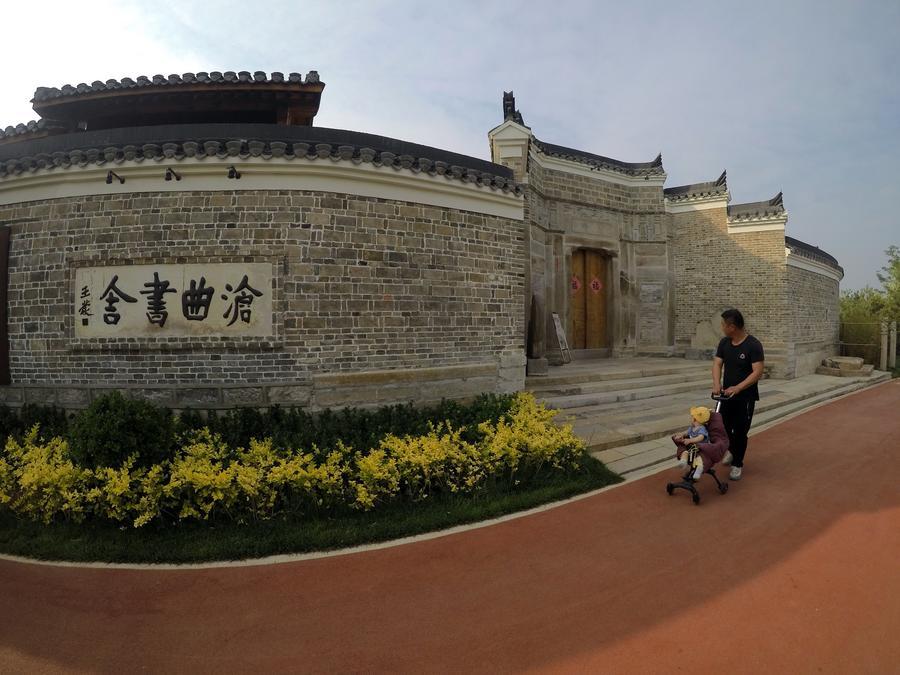
Citizens walk past the yard of an ancient academy along the Grand Canal in Cangzhou City, north China's Hebei Province, May 24, 2022. (Xinhua/Luo Xuefeng)
At a time when the "Clash of Civilizations" theory still has a foothold in the world, and divisions and conflicts hinder human progress, Chinese academies, with their thousand years of practice, offer Eastern wisdom that promotes dialogue and strengthens cooperation.
NANCHANG, China, March 16 (Xinhua) -- As the world seeks ways to engage in dialogue across different civilizations while preserving distinct identities, "shuyuan," or ancient Chinese academies, have emerged as a guide from Chinese history.
SEEKING CONSENSUS AMID DIFFERENCES
Originating in the Tang Dynasty (618-907), "shuyuan" were unique Chinese institutions combining education, libraries, ritual observance and scholarly debate. By the Song Dynasty (960-1279), they had become China's primary intellectual hubs, where scholars often engaged in critical reflections, rigorous exchanges and debates.
Chinese "shuyuan" wisdom began resonating with the West during the Ming Dynasty (1368-1644). In the late 16th century, Italian missionary Matteo Ricci visited the Yuzhang Academy in Nanchang, east China's Jiangxi Province, and enjoyed the company of Zhang Huang, then head of the renowned Bailudong (White Deer Grotto) Academy. Ricci brought knowledge of Western astronomy, geography and mathematics, while Zhang inherited a millennia-old Confucian theory. Ricci studied the Confucian classics under Zhang's guidance, while Zhang incorporated Western geographical knowledge into his own work, featuring mutual respect and interaction.


