Across China: Portraits bring Long March martyrs back into view
2026-05-12 14:57 Xinhua
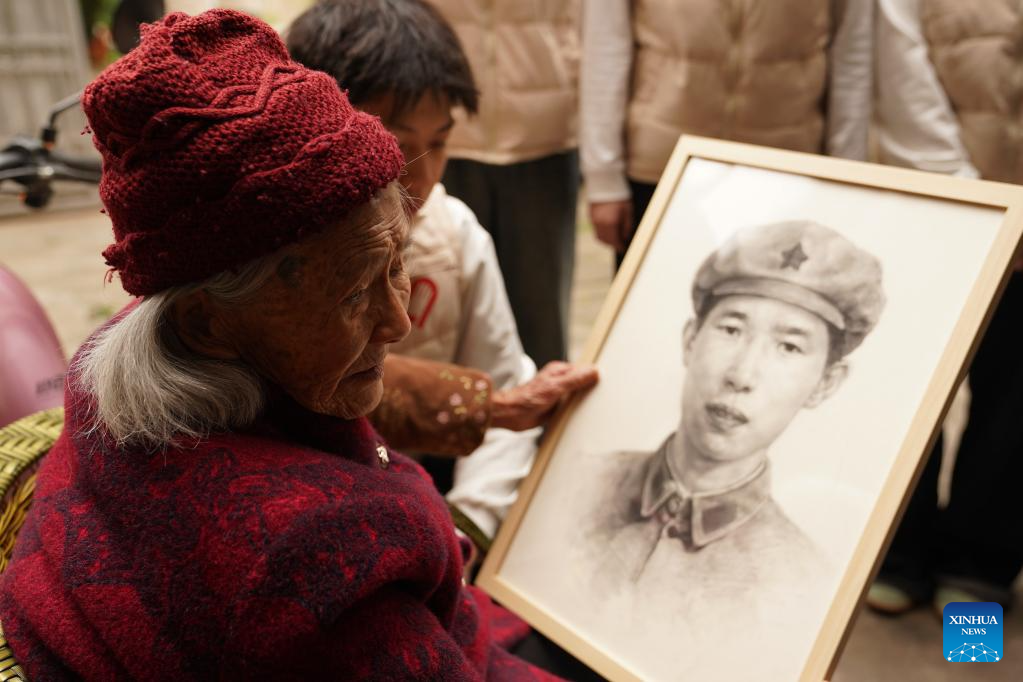
Zhong Xindi holds the portrait of his father Zhong Yanzhu, a Red Army martyr, in Ruijin, east China's Jiangxi Province, April 1, 2026.(Xinhua/Zhou Mi)
NANCHANG, May 11 (Xinhua) -- For more than nine decades, Zhong Xindi knew her father mostly in absence.
He had left home when she was three, joined the Red Army, and later died during the Long March, the historic military maneuver in modern Chinese history. There was no photograph to remember him by, no familiar face for the family to hold onto, only a name, and the knowledge that he had never returned.
Then, a little more than a month ago, students from Anhui Normal University brought the 94-year-old a portrait of her father, Zhong Yanzhu, when he was young.
"Dad, I finally saw your face again," Zhong said, stroking the painted cheek with a trembling hand as tears ran down her face.
In Ruijin, east China's Jiangxi Province, absences like Zhong's are woven into the memory of the Long March. More than 90 years ago, the county had a population of about 240,000. Some 113,000 people joined the Red Army, and more than 30,000 local soldiers set out on the Long March. Over 10,800 of them died along the way. Many left behind no photograph at all.
Now, a project to paint portraits of Red Army martyrs is giving some families a face to attach to stories passed down for generations. The first batch included 151 portraits, created by college students, not from imagination, but from careful reconstruction.


