Outsmarting climate change with high-tech at Mogao Grottoes
2026-08-04 09:47 Source
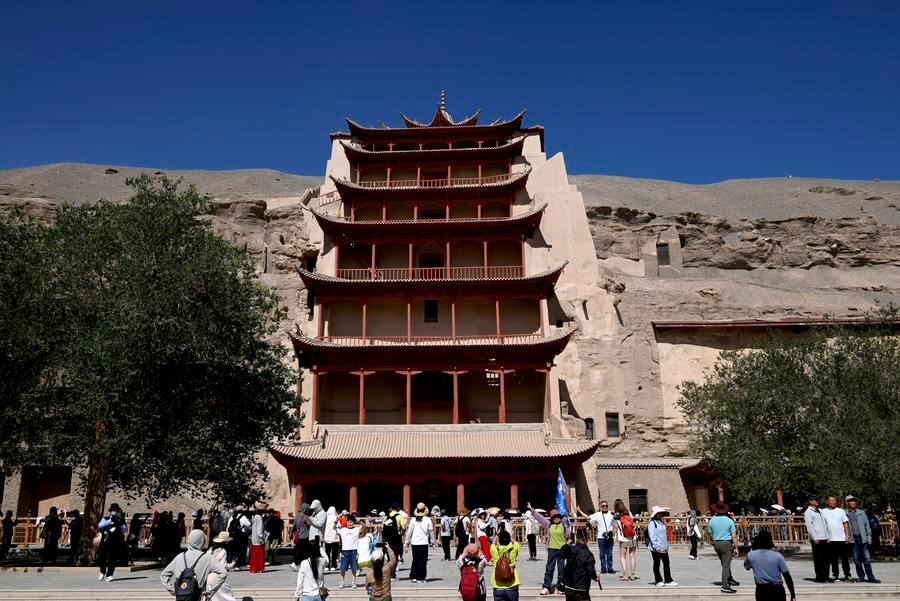
Tourists visit the Mogao Grottoes in Dunhuang, northwest China's Gansu Province, June 21, 2026. (Photo by Zhang Xiaoliang/Xinhua)
LANZHOU, Aug. 3 (Xinhua) -- Visitors to the Mogao Grottoes often find themselves lost in reverie before the exquisite murals and delicate sculptures, swept away by centuries of Buddhist art and history.
Few ever glance back at the unassuming gray cave doors behind them. Yet those plain metal panels are anything but ordinary. They are the cave's quiet sentinels, programmed to slide open automatically when carbon dioxide levels rise too high, letting in a cleansing breath of fresh air before the ancient pigments can be harmed.
These smart doors exemplify how the world-renowned Mogao Grottoes are harnessing technology to adapt to a changing climate.
Carved into cliffs deep in the Gobi Desert in Dunhuang, northwest China's Gansu Province, the Mogao Grottoes date back to 366 A.D. Of the 735 surviving caves, 492 are decorated with murals and painted sculptures. UNESCO has recognized the site as the world's largest, best-preserved and longest-serving treasure house of Buddhist art.
Arid conditions have been key to preserving the Mogao Grottoes for thousands of years. However, meteorological data show that the region is becoming both warmer and wetter.
Since 2000, the rate of precipitation increase in northwest China has been eight times that recorded between 1961 and 2000, according to meteorological data.
