Bilingual volunteers bridge cultures to share 5,000-year story of Chinese civilization
2026-08-10 10:17 Xinhua
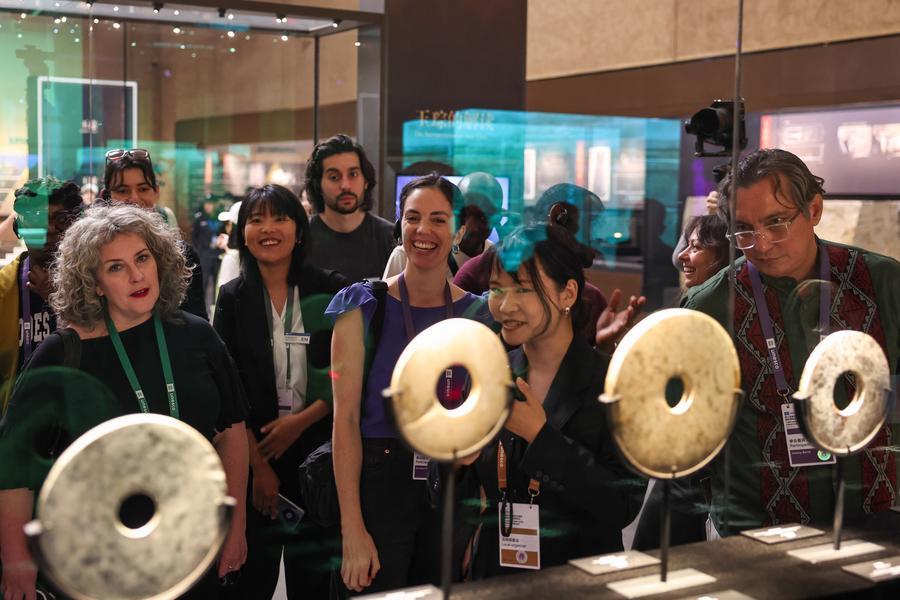
Guests attending the third UNESCO High-Level Forum for Museums visit the Liangzhu Museum in Hangzhou, east China's Zhejiang Province, on April 23, 2025. (Xinhua/Jiang Han)
HANGZHOU, Aug. 8 (Xinhua) -- Clad in a red volunteer vest bearing a badge in the shape of a jade-inlaid lacquer cup, one of her favorite Liangzhu artifacts, American Emma Chen greeted visitors to the Liangzhu Museum in east China, and then shared stories of a civilization that flourished more than 5,000 years ago.
For Chen, the ancient artifacts on display are more than relics from the past. They offer a glimpse into the wisdom of the Liangzhu people, showcasing their sophisticated social structure, farming practices and exquisite jade craftsmanship, dating back to the Neolithic age.
"Although no written records of the Liangzhu people have been found, archaeology, together with later historical texts, allows us to gradually piece together their way of life and better understand the cultural legacy they left behind," she said.
The Liangzhu ruins, located in Hangzhou, capital city of east China's Zhejiang Province, have been recognized as a testimony to the existence of Chinese civilization at least 5,000 years ago. They have also been inscribed on the UNESCO World Heritage List.
Starting from 2023, the Liangzhu Forum has been held annually to gather global archaeologists, historians, museum directors and artists to discuss world civilizations, heritage conservation and cross-cultural dialogue. The forum has also contributed to several international cooperation projects, including the establishment of an archaeological research center focused on Liangzhu.


