Ancient Silk Road passage in northwest China expands global ties
2026-09-01 10:52 Xinhua
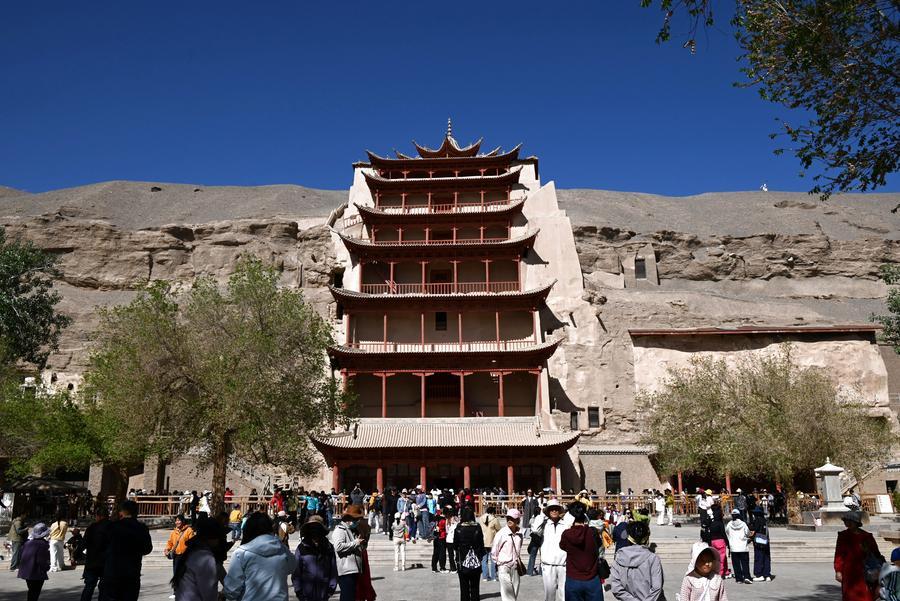
Tourists visit the Mogao Grottoes in Dunhuang City, northwest China's Gansu Province, on May 2, 2026. (Photo by Zhang Xiaoliang/Xinhua)
LANZHOU, Aug. 30 (Xinhua) -- Alejandro Delgado, Deputy Army Attache of the Peruvian Embassy in China, beamed at a cultural event in Beijing on Thursday as he displayed a bookmark featuring the Chinese calligraphy characters "Jixiang," a phrase that means "good fortune."
"I love the Chinese language," Delgado said.
He was among more than 200 guests from 42 countries and international organizations at the special promotion event on the Hexi Corridor. Stretching over a thousand kilometers, the Hexi Corridor served as a key artery on the ancient Silk Road more than 2,000 years ago, connecting China to Central Asia, West Asia and Europe, thereby facilitating the exchange of diverse civilizations.
Five cities along the Hexi Corridor, namely Wuwei, Jinchang, Zhangye, Jiuquan and Jiayuguan in northwest China's Gansu Province, promoted their cultural, tourism and industrial resources at the event. The event also showcased intangible cultural heritage items, cultural and creative products, and local specialties.
"This kind of activity is great for promotion. It helps people see China's diverse products and understand the country from within," Delgado said.
The roadshow has previously traveled to Shanghai and other cities. This year, representatives from the corridor cities converged on Beijing to showcase their history, culture, landscapes and development opportunities to a broader global audience.
"It makes me want to learn more about the province," said Lebanese ambassador to China Milad Raad, who has never visited Gansu.


