Across China: China-U.S. researchers rebuild extinct ancient horse in 3D
2026-09-13 13:01 Xinhua
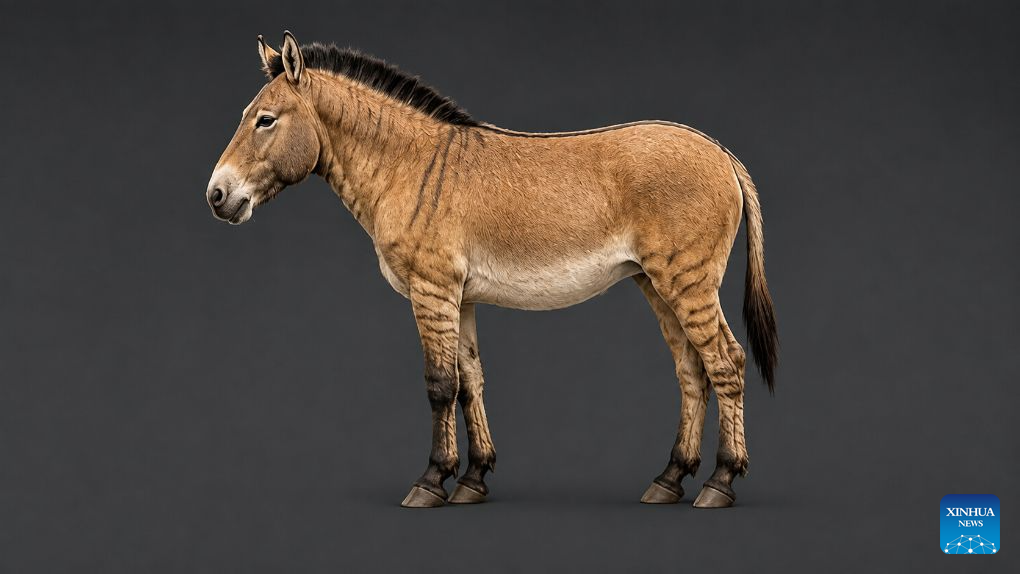
This undated file image provided by Jilin University in northeast China's Jilin Province shows a reconstructed 3D image of Equus ovodovi, an extinct ancient horse. (Jilin University/Handout via Xinhua)
CHANGCHUN, Sept. 11 (Xinhua) -- The year 2026 is the Year of the Horse in the Chinese zodiac, and scientists have welcomed a long-lost relative back to the horse family tree.
A China-U.S. research team has, for the first time, reconstructed the full appearance of an extinct ancient horse, known as Equus ovodovi, giving a face to a species that had puzzled scientists for over a century.
Jilin University in northeast China on Thursday unveiled a 3D image of the animal, a brown-furred creature about the size of a donkey. According to the university, using ancient DNA data and comparative anatomy, its bioarchaeology laboratory carried out the reconstruction in collaboration with U.S. company Evolutio LLC.
This joint work fills a gap in terms of what this animal looked like, and establishes a complete research chain from ancient DNA to visual reconstruction, the university told Xinhua.
The horse fossils, dating back roughly 40,000 years, were first found in a cave in southwestern Siberia in Russia. Initially, only broken jawbones and teeth were discovered, without a complete skull. Over the years, related fossils have also been unearthed in North America, Africa, Siberia and northeast China. However, because the bones were scattered fragments, the animal's true appearance had remained a mystery for more than a hundred years.


