China opens major river-to-sea canal, creating trade shortcut to Southeast Asia
2026-09-16 17:17 Xinhua
The new artery carries particular significance for China's southwest, which has long lagged behind the more prosperous eastern coast and faced higher costs getting goods to seaports. Coal, ore, grain, new-energy materials and auto parts from the region can now take a more direct route to overseas markets.
China's trade with ASEAN exceeded 1 trillion U.S. dollars for the first time last year. In the first seven months of 2026, total trade between the two sides reached 744.41 billion U.S. dollars, an increase of 24.7 percent year on year, accounting for 21.8 percent of China's total foreign trade during this period.
For Boonsub Panichakarn from the Faculty of Logistics and Digital Supply Chain at Naresuan University in Thailand, the canal's significance goes beyond the distance it saves.
It lies in how much the canal can reduce logistics costs, time variability and uncertainty across the entire ASEAN-southwest China supply chain, he said.■
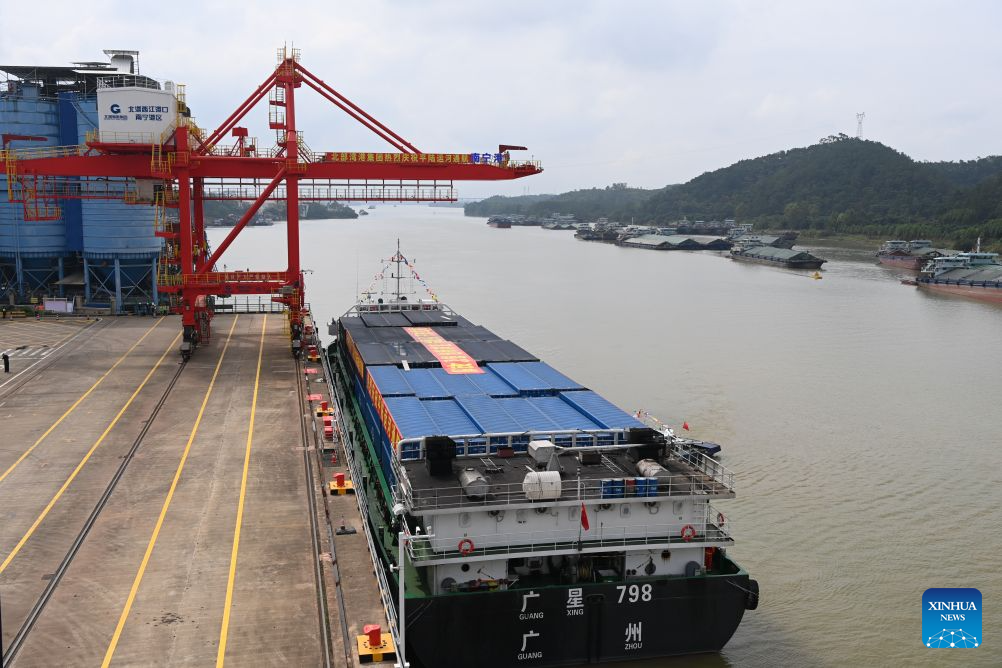
A cargo vessel prepares to depart for Yangpu Port in south China's Hainan Province along the Pinglu Canal, in Nanning Port, south China's Guangxi Zhuang Autonomous Region, Sept. 16, 2026. China opened the Pinglu Canal on Wednesday, giving its landlocked southwest a shortcut to the coast and overseas markets, particularly those in the Association of Southeast Asian Nations (ASEAN), the country's largest trading partner.
Built at a cost of 72.7 billion yuan (about 10.75 billion U.S. dollars), the 134.2-kilometer canal runs from Hengzhou, a county-level city in south China's Guangxi Zhuang Autonomous Region, to the Beibu Gulf, the closest maritime outlet for much of southwest China. (Xinhua/Cao Yiming)


