More smart devices used in China’s household service sector
2026-04-02 10:42 Xinhua
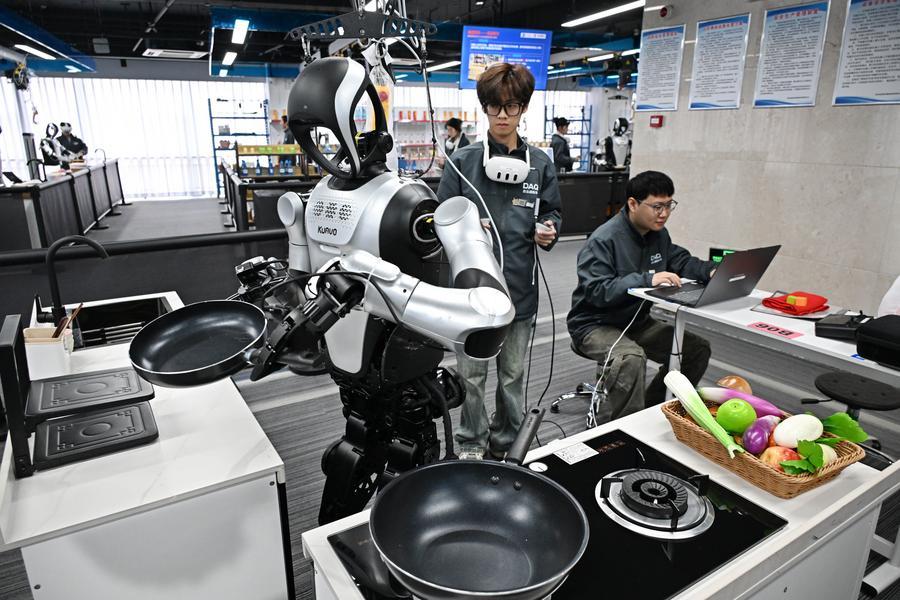
Staff members conduct training and data collection on a humanoid robot at the Qingdao Humanoid Robot Data Training Center in Laoshan District of Qingdao, east China's Shandong Province, March 23, 2026. (Xinhua/Li Ziheng)
HEFEI, April 1 (Xinhua) -- When a newborn stirred in the night, a sensor clipped to the edge of the diaper quietly went to work, sniffing, sensing and logging data.
Within minutes, the caregiver's wristband buzzed and received the latest information about the baby, including the need to change the diaper and the infant's upset stomach.
This gadget, jointly developed by a domestic service company in east China's Anhui Province and an artificial intelligence firm, combines humidity detection with highly sensitive odor sensors.
"It tracks infants' digestive patterns and uploads the data to a digital platform, where it is paired with feeding records kept by caregivers," said Ding Youmei, president of the Anhui-based Wansao, the domestic service company. "The result is a personalized health profile that helps nannies and parents monitor babies more precisely."
The company hopes the technology may eventually serve another demographic, frail elderly people who require constant care.
Such experiments illustrate the growing use of artificial intelligence in the vast but traditionally labor-intensive domestic service industry.
In China, where the domestic service sector already employed more than 30 million people and generated a market value of over 1.2 trillion yuan (about 173.43 billion U.S. dollars) in 2024, the arrival of algorithms is expected to reshape how households find help and how such help is delivered.


