South China’s highly interconnected Greater Bay Area drives tech innovation
2026-07-06 11:16 Xinhua
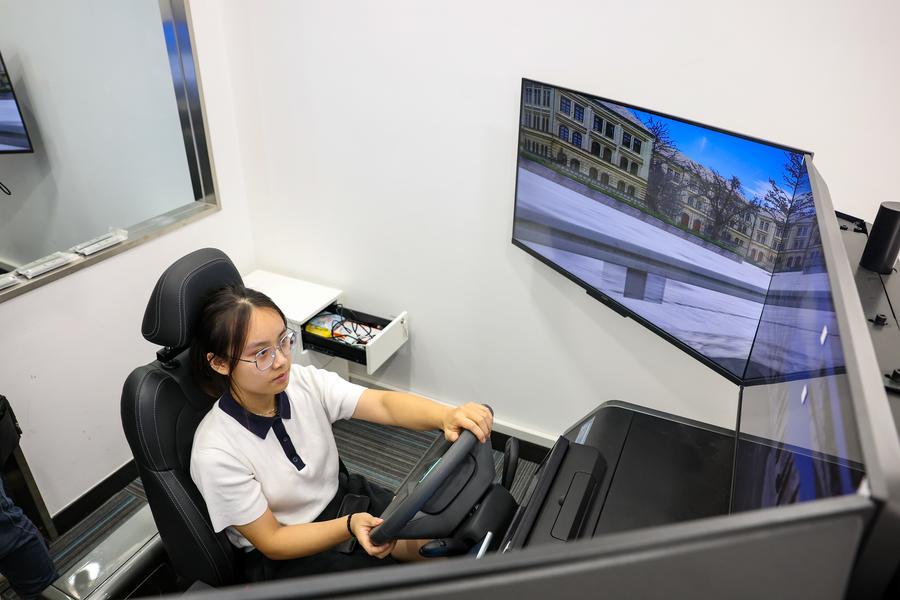
A student operates a driving simulator at the Transportation Behavioral Psychology and Safety Lab of the Hong Kong University of Science and Technology (Guangzhou) in Guangzhou, south China's Guangdong Province, June 30, 2026. (Xinhua/Zhang Yudong)
GUANGZHOU, July 5 (Xinhua) -- In a laboratory in Guangzhou, researchers are using virtual reality systems to better understand how seemingly small adjustments, such as seat heating, can improve passenger comfort while reducing energy consumption.
Research data derived from the laboratory of the Hong Kong University of Science and Technology (Guangzhou), combined with simulation systems developed in Hong Kong, about two to three hours' drive away, have been converted into technologies that help vehicles consume less energy without compromising comfort or safety.
"Our research had previously focused on drivers' behavior analysis with little attention paid to the cockpit environment as a potential influencing factor," said He Dengbo, head of the traffic psychology and safety lab. "So working with researchers in Hong Kong who specialize in energy consumption control and cockpit environment simulation has opened up entirely new research directions."
The collaboration illustrates how the Guangdong-Hong Kong-Macao Greater Bay Area (GBA) is combining the complementary strengths of its three regions to foster technological innovation, reinforcing its position as one of China's leading innovation hubs.
He's laboratory has partnered with local automakers to turn its research findings into practical industrial applications.
"We have established a self-reinforcing cycle integrating industry, academia, research and application within the Greater Bay Area," he said.


