South China’s highly interconnected Greater Bay Area drives tech innovation
2026-07-06 11:16 Xinhua
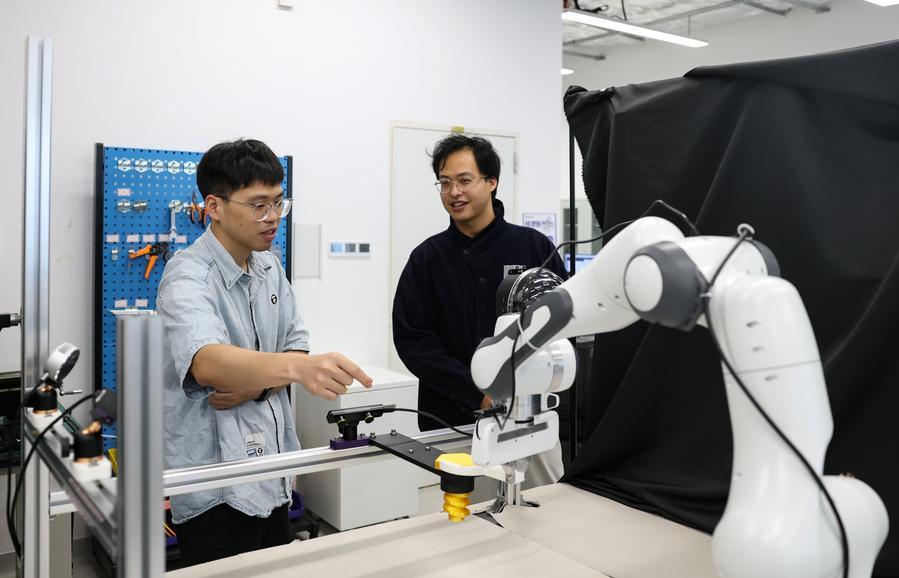
A student (L) talks with a teacher at the Hong Kong University of Science and Technology (Guangzhou) in Guangzhou, south China's Guangdong Province, June 30, 2026. (Xinhua/Zhang Yudong)
Officially opened in 2022, the Hong Kong University of Science and Technology (Guangzhou) has adopted an innovative cross-disciplinary academic structure and aims to become a leading university renowned for its interdisciplinary excellence. It currently covers 16 academic fields, including advanced materials and artificial intelligence.
It is also among a number of campuses and research institutions set up in Guangdong by Hong Kong- and Macao-based universities. Currently, universities based in Hong Kong and Macao have established 31 research and development institutions in Guangdong, while the GBA is home to 45 state key laboratories.
Spanning 56,000 square km across Hong Kong, Macao and nine cities in Guangdong Province in the Pearl River Delta, the GBA has long been a highly interconnected economic hub, linked by shared Cantonese dialect, convenient population mobility and integrated industrial chains. It is leveraging these advantages to foster innovation through closer integration of talent, research and industry.
Coordination among universities, enterprises and the government is essential to driving the transformation.
Guangdong has abundant scientific and educational resources, while Hong Kong and Macao have strong capabilities in basic research, frontier exploration and international collaboration, said Chen Yushan, deputy head of the Guangdong Institute of Science and Technology Information.