At the gateway to China’s resistance, war scars remain as life blooms
2026-08-01 14:54 Xinhua
It was on July 7, 1937, that Japanese troops attacked the Chinese garrison near the Lugou Bridge and began shelling the town, marking the escalation of Japan's aggression into a full-scale invasion and the start of China's nationwide resistance.
"We visited many places in Beijing before finalizing our shop location. When we came to Wanping, we felt this was where we belonged," said Liu. "The history here gives the town a special character, and porcelain is also part of Chinese history. We felt they belonged together."
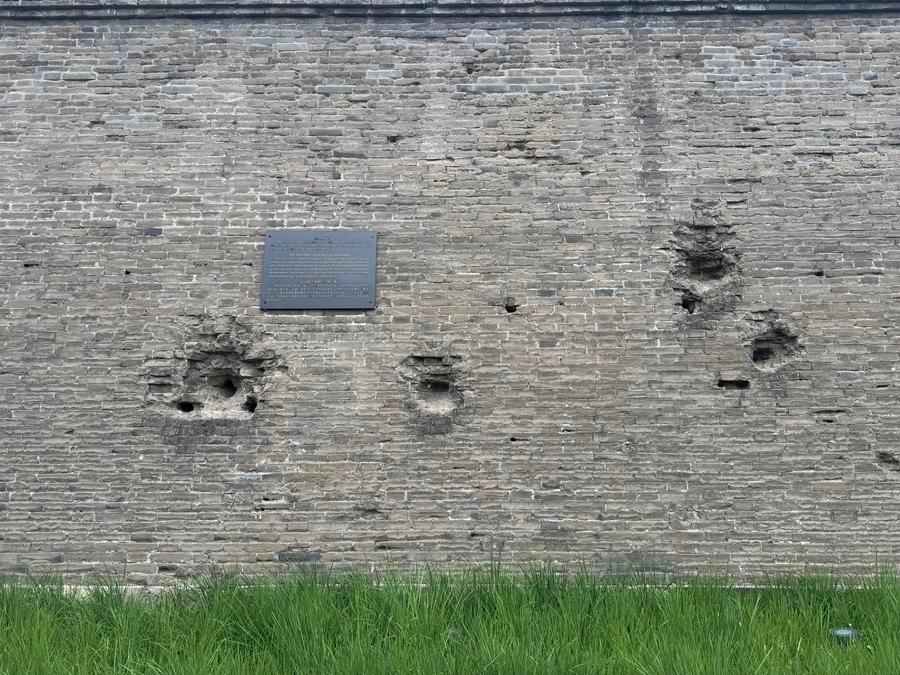
This photo taken on July 10, 2026 shows shell craters on the wall of Wanping, a fortress town, in Beijing, capital of China. (Xinhua/Yang Shenshen)
Over the past 89 years, while the war-inflicted scars endure, the town has transformed. Across the street from Liu's porcelain shop stands the Museum of the War of Chinese People's Resistance Against Japanese Aggression, a symbol of this transformation.
"When I was little, the museum was very small," Liu said.
Following a 10-month expansion and renovation, the museum officially reopened in July 2025. Now housing 1,525 historical photos and 3,237 cultural relics, it stands as China's only large comprehensive memorial museum fully documenting the history of the war.
To preserve Wanping's historic integrity, the new exhibition hall was built underground beneath the adjacent Lion Dance Square, avoiding visual disruption to the ancient town landscape above.
History is also tangible beyond the exhibition halls. Along the ancient walls, shell scars left during the war have been carefully preserved rather than repaired, serving as silent memorials to a painful chapter.


