At the gateway to China’s resistance, war scars remain as life blooms
2026-08-01 14:54 Xinhua
A Beijing resident surnamed Yang, who visited Wanping for the first time, paused beside a shell scar to take photos. "I had seen pictures online, but standing here in person is completely different. You can really feel how close history is," he said. "We do not live in a peaceful age, but we are fortunate to live in a peaceful nation."
In recent years, local authorities have spearheaded comprehensive urban renewal efforts in Wanping, balancing historical conservation with high-quality development.
Since 2023, nearly 3,000 square meters of illegal structures attached to the city walls have been removed, reopening historic views that had long disappeared. Restrictive barriers around key heritage sites have also been replaced with visitor-friendly signposts designed to encourage cultural appreciation.
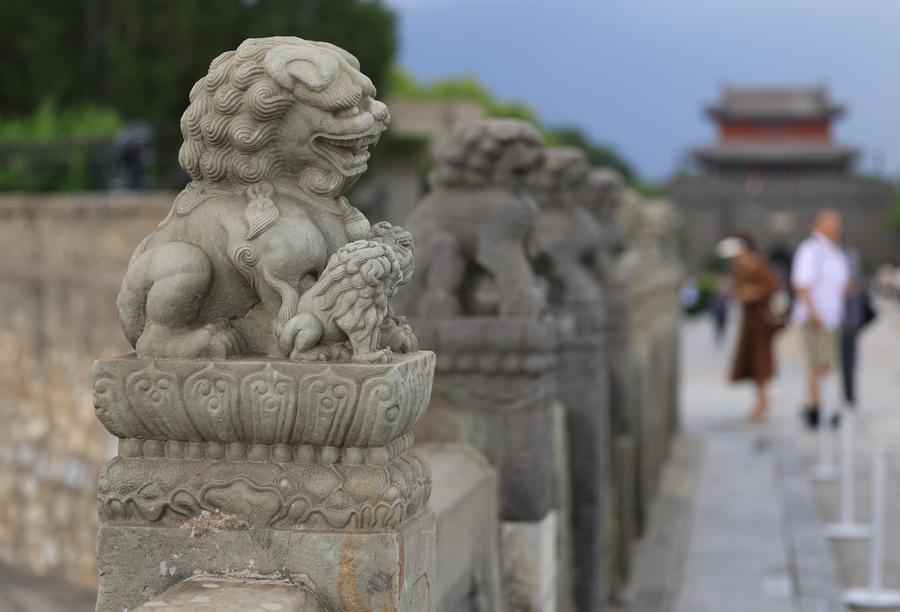
This photo taken on July 7, 2026 shows a view of the Lugou Bridge in Fengtai District of Beijing, capital of China. (Xinhua/Zhang Chenlin)
"We hope to make history easier to understand by bringing people closer to it," said Shen Jin, deputy general manager of Beijing Fengtai Culture and Tourism Group.
This sense of proximity drew Wang Deqiang and his 14-year-old daughter from Guangdong Province. "I've learned about the war in history class, and I want to see these relics with my own eyes," said the girl.
A similar motivation brought 80-year-old Xiong from Nanchang City in east China's Jiangxi Province. "The last time I came to Beijing was in 1992. This time, I wanted to take a closer look at Lugou Bridge," she said.


