At the gateway to China’s resistance, war scars remain as life blooms
2026-08-01 14:54 Xinhua
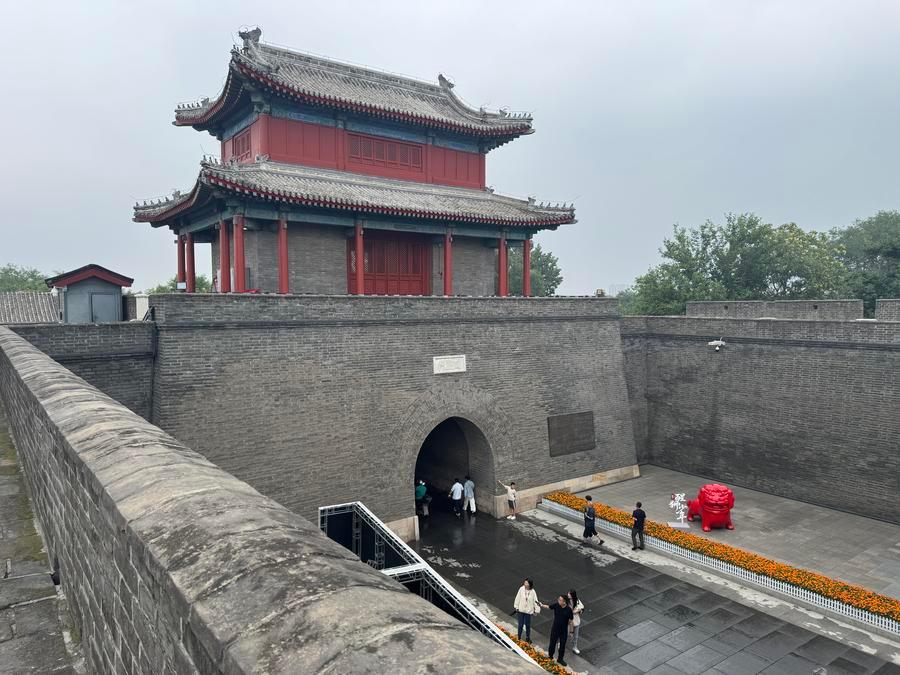
This photo taken on July 10, 2026 shows a view of Wanping, a fortress town, in Beijing, capital of China. (Xinhua/Yang Shenshen)
BEIJING, July 31 (Xinhua) -- At a site in Beijing where pockmarks from artillery shells still scar the ancient city walls, a new shop selling porcelain from China's porcelain capital Jingdezhen has opened its doors recently.
Instead of settling in a busy shopping mall or a hutong with a cultural vibe, China X, locally known as "Green Porcelain House," has chosen Wanping, a fortress town about 20 kilometers southwest of Tian'anmen Square. There, the ancient city walls still bear shell scars left from the Chinese People's War of Resistance Against Japanese Aggression.
At first glance, the pairing seems unusual: one represents Jingdezhen's ceramics heritage, while the other embodies the country's wartime memory. Yet, as ongoing renewal projects accentuate the town's historic features, a growing number of businesses are gravitating towards Wanping, enhancing its heritage attraction.
For shop owner Liu Siyang, however, the location choice went far beyond commercial considerations.
"I was born and raised at the west end of Lugou Bridge, right next to Wanping," said Liu. "I can still remember that when it rained, water would stream through the shell scars in the wall like little waterfalls. As a kid, I thought it was fun, without understanding what those scars truly signified."
The Lugou Bridge, also known as the Marco Polo Bridge, has stood for over 800 years and long served as a key gateway into Beijing.


